Multigrid Methods
Synopsis
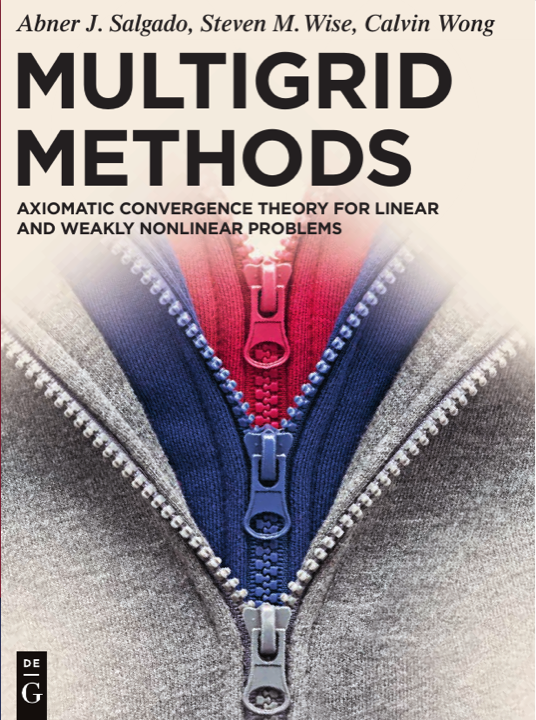
Multigrid Methods: Axiomatic Convergence Theory for Linear and Weakly Nonlinear Problems is our 2026 textbook on multigrid methods for graduate and advanced undergraduate students, published by De Gruyter. Written by Abner Salgado, Calvin Wong, and me, the book is our attempt to make the subject accessible and understandable to a modern audience.
This book introduces the theory and application of multigrid methods for the fast numerical solution of linear and weakly nonlinear elliptic PDE. No previous exposure to numerical discretization methods is assumed. All that is required of the reader is curiosity and some basic knowledge of matrix theory and the theory of finite-dimensional vector spaces.
We use an axiomatic, mostly matrix-based approach to present the theory in a natural setting and translate it into practical code. In the latter part of the book, we depart slightly from this approach when presenting the framework for nonlinear problems. That nonlinear analysis, based on subspace decompositions, represents an area of current research. The book takes the reader from fundamental concepts and implementation issues to the frontiers of multigrid research.
Implementing multigrid methods is notoriously difficult. The book contains several examples using finite element and cell-centered finite-difference frameworks, helping readers construct sophisticated, efficient multigrid code in MATLAB.
Availability
The electronic version of the book is available from De Gruyter. You may ask your university library to purchase campus-wide access for students and faculty. Physical copies are available from Amazon.
Errata
The current errata are available from the book’s GitHub repository. Errors, typographical mistakes, and inconsistencies may be reported to any of the authors. We greatly appreciate any feedback you can provide.
Code and Supplementary Materials
The MATLAB code listed in the book is available from the GitHub repository stevenmwise/MultigridCourse. The repository also contains the source code used to generate the book’s tables and figures. We plan to add more software and supplementary material over time.